The 72 Angels

An exploration of the Shem HaMephorash — how 72 divine names emerge from Scripture, how four guardian angels are derived from the sky at your birth, and how the Kabbalistic Tree of Life reveals each angel’s domain of light and its shadow.

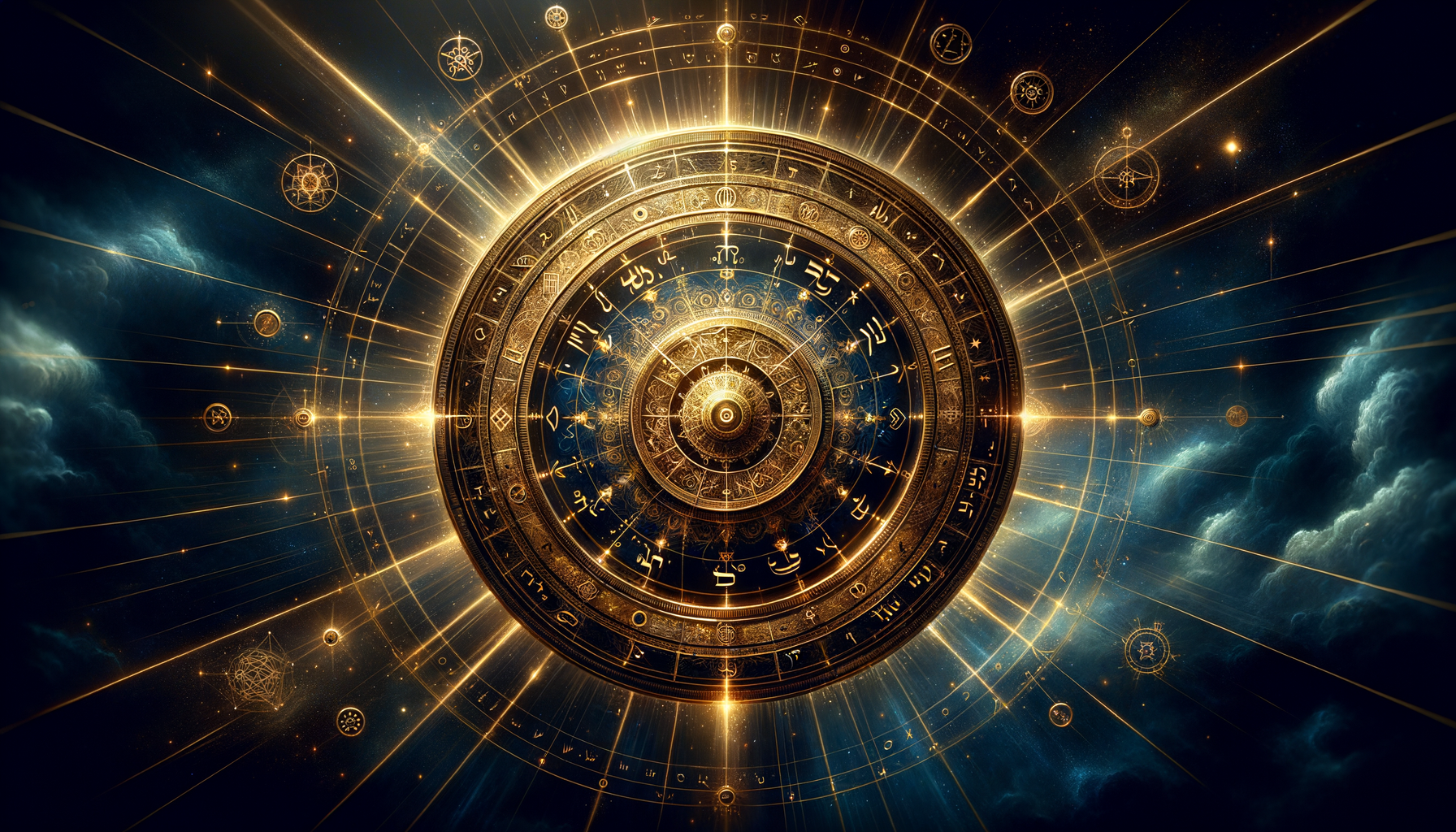
The 72 angels arranged around the zodiac wheel, each governing five degrees of the ecliptic
Origin

The Name of 72 Letters

In the Book of Exodus, there is a passage that most readers experience as narrative — the parting of the Red Sea. Three verses, Exodus 14:19–21, describe the angel of God moving from the front of the Israelite camp to the rear, the pillar of cloud shifting with it, and Moses stretching his hand over the sea. What the Hebrew text conceals in plain sight is a mathematical symmetry: each of these three verses contains exactly 72 Hebrew letters.

The Kabbalistic tradition takes this as more than coincidence. By writing the first verse left-to-right, the second right-to-left (boustrophedon), and the third left-to-right again, then reading downward in columns of three, 72 unique trigrams emerge. Each trigram becomes the root of an angelic name, completed with the divine suffix -el (“of God”) or -iah (“of Yah”). This is the Shem HaMephorash — the “explicit” or “divided” name of God, fractured into 72 facets, each carried by an angel.

These 72 names are then mapped onto the ecliptic — the apparent path of the Sun through the zodiac — in arcs of exactly 5° each. The first angel, Vehuiah, governs 0°–5° Aries; the seventy-second, Mumiah, governs 355°–360° Pisces. The zodiac becomes a wheel of names, and the position of the heavens at the moment of your birth places you within the arc of a specific angel — or rather, within the arcs of several, depending on which astronomical lens you look through.

72 × 5° SHEM HAMEPHORASH
The ecliptic divided into 72 angelic arcs of 5° each, aligned to the twelve zodiac signs
The Four Planes

Four Angels, Four Lenses

A common misconception is that you have one guardian angel. The Kabbalistic tradition disagrees. It holds that every person stands at the intersection of four angelic influences, each derived from a different measurement of the heavens at the moment of birth. Together they form a composite portrait — not a single note, but a chord.

Think of it this way: four people might look at the same sky and ask four different questions. Where is the Sun right now? yields the Solar angel, your core identity. How far are we through the year? yields the Intellectual angel, your cognitive archetype. What date is it on the sacred calendar? yields the Emotional angel, your temperament. What hour of the day is it, measured by the light? yields the Operative angel, the angel of action in the present moment. Same sky, four distinct answers, four guardians.

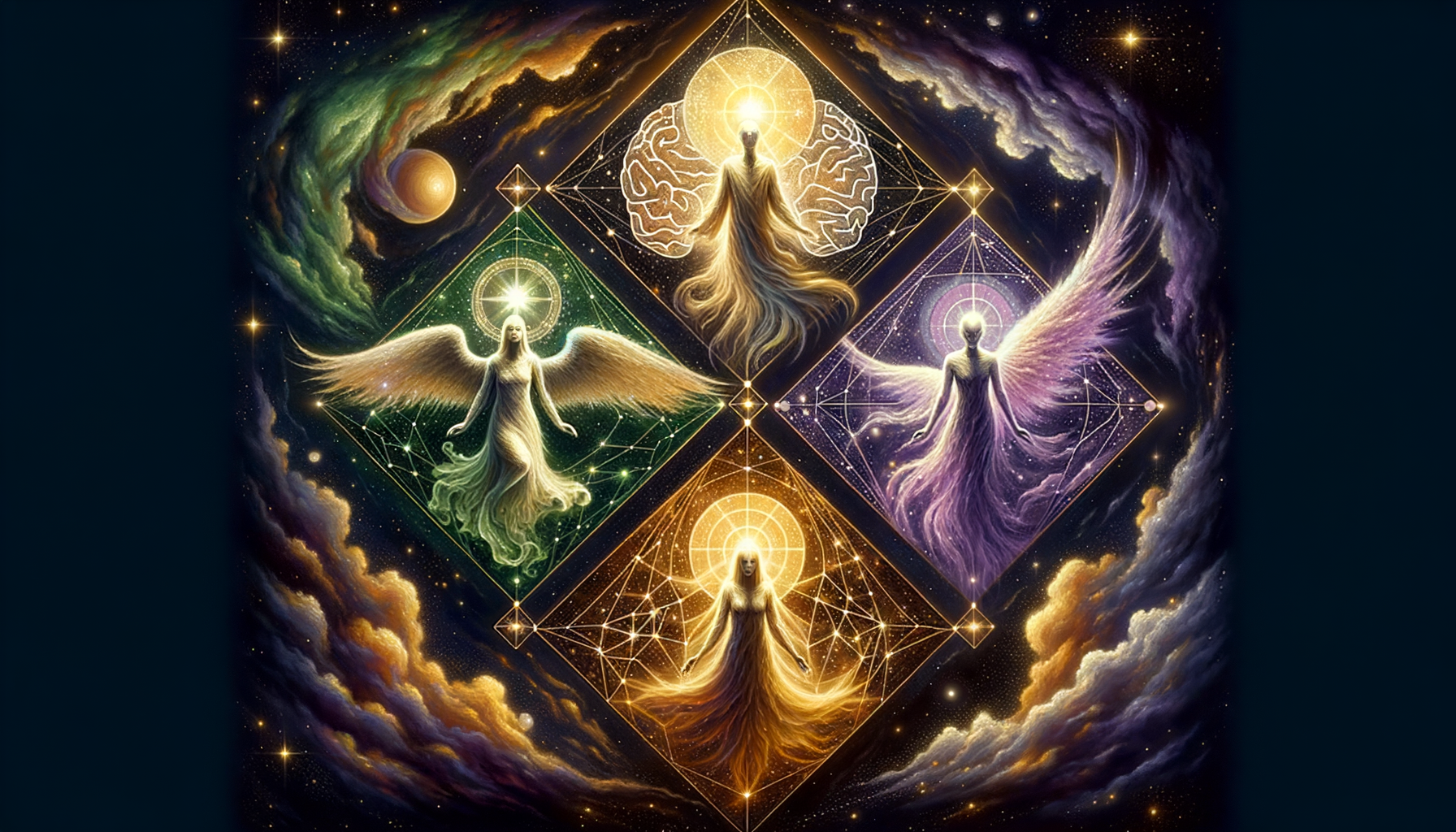
Four guardian angels representing the solar, intellectual, emotional, and operative planes
The four angelic planes: Solar identity, Intellectual cognition, Emotional temperament, Operative action

The Solar Angel is the one most traditions simply call the “guardian angel.” It is derived from the true apparent longitude of the Sun at the moment of birth. Since the 72 names divide the ecliptic into arcs of exactly 5°, whichever arc held your Sun is your angel. This is the oldest and most direct application of the Shem HaMephorash — Agrippa codified it in his Three Books of Occult Philosophy (1531), describing the “seventy two Celestial quinaries” and the angels set over them. The logic is simple: the 72 trigrams extracted from Exodus are mapped onto the zodiac in order, and the Sun’s position at birth selects your name. The solar angel governs identity, vitality, and life purpose — the quality of divine light the Sun was channeling when you arrived.

The Intellectual Angel uses a different measurement of the same sky. Rather than the Sun’s actual position — which moves at a slightly variable rate due to orbital eccentricity — it divides the tropical year into 72 equal periods of approximately 5.07 days, measured from the exact moment of the vernal equinox. This method appears in the modern Kabbalistic tradition through Haziel’s The 72 Angels of the Kabbalah (1988), though it draws on an older Hermetic distinction between the phenomenal Sun (where it actually is) and the ideal Sun (where it would be if it moved uniformly). The Golden Dawn also recognized this separation. The intellectual angel governs cognition — how you reason, what patterns you gravitate toward, the architecture of your understanding. Where the solar angel is your spiritual identity, the intellectual angel is your mental signature.

The Emotional Angel comes from an entirely different system: a fixed calendar of dates rather than an astronomical calculation. The primary source is Lazare Lenain’s La Science Cabalistique (1823), later elaborated by Charles Barlet in his 1909 edition. In this system, each of the 72 angels is assigned five dates across the year, spaced approximately 73 days apart — forming a pentagrammatic pattern, a five-pointed star inscribed in the circle of the year. The pentagram is a deliberate choice: in Kabbalistic symbolism it represents the human being, the microcosm within the macrocosm. Pat Zalewski, in his Kabbalah of the Golden Dawn, identifies Lenain’s work as the likely basis for the Golden Dawn’s own angel calendar. The emotional angel governs temperament, relational instincts, and the texture of your inner feeling-life. Your birth date on this calendar — independent of the Sun’s astronomical position — determines which angel shapes your emotional nature.

The Operative Angel is the only one that is not fixed at birth. It is computed from planetary hours — the ancient system of dividing daylight into 12 unequal segments from true sunrise to true sunset, and night into 12 more from sunset to the next sunrise. Agrippa describes this system in detail in Book II of the Occult Philosophy, noting that the hours are “unequal” because they expand and contract with the seasons. William Lilly’s Christian Astrology (1647) refined the practice by anchoring it to observed sunrise and sunset at the practitioner’s latitude. The Zohar makes the angelic connection explicit: “different angels govern different hours of the day and night, different days of the week, different months, and different seasons.” Each planetary hour is subdivided into three angel segments, cycling all 72 angels through every 24-hour period — 36 during the day, 36 at night. The operative angel changes roughly every 20 minutes and governs what you can do right now: the angel of practical action and present-moment influence.

The Tree of Life

The Sephiroth

The Kabbalistic Tree of Life — the Etz Chaim — is the central map of Jewish and Hermetic mysticism. It describes ten Sephiroth (singular: Sephira), which are emanations or attributes through which the Infinite (Ein Sof) reveals itself in creation. They are not places so much as qualities of divine expression, arranged in a descending cascade from pure unity at the top to manifest reality at the bottom.

The ten Sephiroth, from crown to kingdom, are: Kether (Crown, pure will), Chokmah (Wisdom, the first creative impulse), Binah (Understanding, the form that receives), then Chesed (Mercy, expansive generosity), Geburah (Severity, disciplined strength), Tiphereth (Beauty, the harmonizing center), then Netzach (Victory, desire and creative passion), Hod (Splendor, intellect and communication), Yesod (Foundation, the subconscious bridge), and finally Malkuth (Kingdom, the physical world).

What makes the Tree relevant to the angel system is the tradition — codified most systematically by the Hermetic Order of the Golden Dawn and preserved in Aleister Crowley’s 777 — of mapping the seven classical planets to seven of these Sephiroth. Saturn corresponds to Binah, the sphere of structure and limitation. Jupiter to Chesed, mercy and abundance. Mars to Geburah, severity and focused will. The Sun to Tiphereth, balance and illumination. Venus to Netzach, love and creative desire. Mercury to Hod, thought and communication. The Moon to Yesod, the unconscious and the tides of the psyche.

This mapping is not arbitrary. Each Sephira describes a mode of divine action, and each planet has always been understood — across cultures, from Babylonian to Hellenistic to medieval — as embodying a similar mode. The Tree simply makes the correspondence explicit and places it within a single coherent structure.

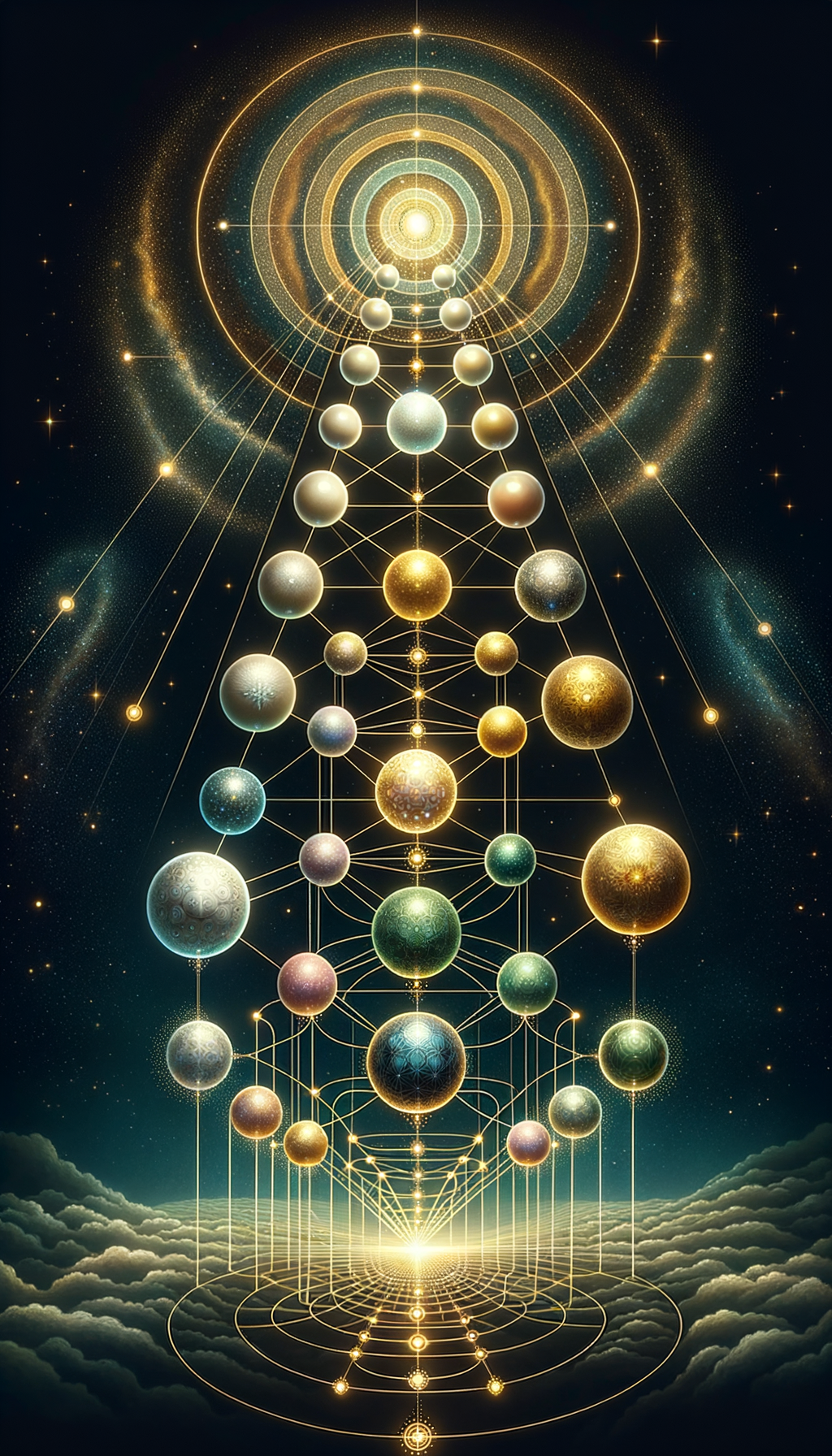
The Kabbalistic Tree of Life showing ten Sephiroth with planetary correspondences
The Tree of Life — ten Sephiroth mapped to the seven classical planets
Planet Sephira Quality Signs Ruled
SaturnBinah (3)Structure, limitation, understanding through formCapricorn, Aquarius
JupiterChesed (4)Mercy, expansion, benevolent abundanceSagittarius, Pisces
MarsGeburah (5)Severity, will, disciplined strengthAries, Scorpio
SunTiphereth (6)Beauty, harmony, the illuminated centerLeo
VenusNetzach (7)Victory, desire, creative passion, loveTaurus, Libra
MercuryHod (8)Splendor, intellect, language, communicationGemini, Virgo
MoonYesod (9)Foundation, the unconscious, intuition, rhythmCancer
Dual Mapping

Sign Sephira and Decan Sephira

This is where the system becomes genuinely original in its synthesis. Every angel governs a 5° arc of the zodiac. That arc sits inside a sign (30°) and inside a decan (10°). Both the sign and the decan have planetary rulers, and both of those planets correspond to Sephiroth on the Tree. So every angel inherits two sephirotic influences — a dual coordinate on the Tree of Life.

The sign Sephira comes from the classical planetary ruler of the zodiac sign. Aries is ruled by Mars, so any angel in Aries carries the energy of Geburah — severity, focused will, the cutting edge that separates and defines. Taurus is ruled by Venus, so its angels carry Netzach — desire, beauty, the pull toward connection. This gives the angel its broad zodiacal character: the quality of the season, the elemental environment it lives in.

The decan Sephira comes from the Chaldean decan system, one of the oldest astrological frameworks we have. Each sign is divided into three decans of 10°, and the decans cycle through the seven planets in Chaldean order: Mars, Sun, Venus, Mercury, Moon, Saturn, Jupiter, repeating. The decan ruler gives the angel its temporal quality — its position in the unfolding sequence within the sign, whether it belongs to the beginning (initiative), middle (development), or end (completion) of that sign’s story.

When you combine the two, you get a specific path on the Tree. An angel in the first decan of Aries, for instance, has Mars as both sign ruler and decan ruler — a double Geburah, pure martial energy, the igniting spark. An angel in the second decan of Taurus has Venus (Netzach) as its sign ruler but the Sun (Tiphereth) as its decan ruler — beauty illuminated by harmony, desire that finds its center. These combinations are what give each angel its unique flavor within the system, and they are the foundation on which the angel’s domain and shadow are built.

Why two Sephiroth? A single mapping would tell you that an Aries angel is “martial.” The dual mapping tells you how it is martial — whether its severity is tempered by solar beauty (Geburah → Tiphereth), deepened by saturnine structure (Geburah → Binah), or intensified by its own nature (Geburah → Geburah). The second Sephira is the inflection that makes each angel distinct.

Light and Inversion

Domain and Shadow

Every angel carries a domain — a sphere of life and set of qualities that it governs, nurtures, and empowers. The domain is the angel at work in your life when its influence flows without obstruction: the virtues it cultivates, the capacities it strengthens, the areas of experience it illuminates. If your solar angel’s domain includes creative drive, confidence, and leadership, those are the qualities that come naturally to you when you are aligned with that angel’s energy. They are your gifts, your native strengths, the channels through which divine influence reaches you most directly.

But every domain has a shadow, and this is where the system reveals its deepest insight. The shadow is not a separate force. It is not a “dark angel” or an opposing entity. The shadow is the angel’s own domain turned against itself — the same qualities, distorted by excess, rigidity, or neglect. It is what happens when the angel’s influence is abused, resisted, or opposed.

Consider an angel whose domain is truth-seeking and discernment. When that energy flows constructively, the person sees clearly, speaks honestly, and cuts through confusion. But when the same energy is distorted — pushed to its extreme, or turned inward against the self — truth-seeking becomes self-righteous judgment. Discernment becomes ruthless criticism. The angel of truth becomes the source of cruelty, not because the force changed, but because its expression did.

Or take an angel whose domain is nurturing and emotional generosity. In its light, this manifests as warmth, care, the ability to hold space for others. In its shadow, the same impulse becomes smothering, codependence, or emotional manipulation — generosity that has lost its boundaries and become a tool of control. The nurturer who cannot stop giving is not channeling a different force than the nurturer who gives freely; they are channeling the same force through a distorted lens.

This principle has deep roots in Kabbalistic thought. The tradition of the Qliphoth — the “shells” or “husks” that represent the shadow side of each Sephira — holds that every emanation of the divine contains within it the potential for its own corruption. Chesed (Mercy) without limit becomes indulgence and moral weakness. Geburah (Severity) without mercy becomes tyranny and destruction. The Qliphoth are not enemies of the Sephiroth; they are the Sephiroth themselves, hollowed out, operating without the balance of the Tree.

Kairos applies this principle directly to each angel. Because we know the angel’s sephirotic coordinates — both sign and decan — we can identify not only what the angel governs but what the distortion of that governance looks like. An angel rooted in Netzach (desire, passion) and Hod (intellect, communication) has a domain of articulate desire — the ability to name what you want and pursue it with eloquence. Its shadow is seductive manipulation — the same eloquence weaponized, desire that uses language to control rather than connect.
Domain and shadow as two faces of the same angelic influence — light flowing freely versus light distorted
Domain and shadow — the same divine quality, expressed or distorted

The practical question: Your angel’s domain keywords tell you where your natural strengths live. Its shadow keywords tell you what to watch for when those strengths are under stress, overextended, or operating without self-awareness. The shadow is not a warning about something external. It is a mirror — the cost of your own gifts when they are not held with care.

Application

Reading Your Domain and Shadow

When Kairos displays an angel’s domain, it shows a set of keywords and an expression — a sentence-length description of the angel’s constructive influence. The keywords are not random; they are the specific qualities the angel cultivates across all four planes of its influence (solar, intellectual, emotional, operative). If the domain includes “strategic vision,” “patience,” and “structural thinking,” these describe a person whose natural gifts lie in seeing the long game, holding steady under pressure, and building things that last.

The shadow keywords are the inverted domain. They describe what happens when those same gifts are pushed past their limits or cut off from balance. “Strategic vision” becomes “paranoid calculation.” “Patience” becomes “passive avoidance.” “Structural thinking” becomes “rigid inflexibility.” Each shadow keyword is a direct inversion of a domain keyword, not its opposite but its corruption.

This makes the shadow genuinely useful rather than merely cautionary. If you recognize yourself in the shadow keywords — if “rigid inflexibility” rings uncomfortably true — the system does not diagnose a flaw. It points you back to the domain. The rigidity is not your problem; it is your gift of structural thinking operating without flexibility. The fix is not to abandon structure but to restore its balance. The shadow always contains the instructions for its own healing, because it is the domain, just seen from below.

Because each person has four angels, they also carry four domains and four shadows. The solar domain describes your core identity strengths and their risks. The intellectual domain describes your cognitive gifts and their blind spots. The emotional domain describes your relational capacities and the ways you can lose yourself in them. The operative domain — which changes throughout the day — tells you what kind of action is supported right now and what distortion to watch for in this moment. Together, they form a dynamic, four-dimensional portrait of your relationship with the divine names that govern your arc of the sky.

Degree Angels

The Ars Paulina

Alongside the 72 Shem HaMephorash angels, Kairos implements a second, finer-grained system from a very different tradition: the Ars Paulina, the third book of the Lemegeton (also known as the Lesser Key of Solomon), preserved in British Library manuscript Sloane MS. 3825.

Where the Shem maps 72 angels to arcs of 5°, the Ars Paulina maps 259 distinct angels to individual degrees of the ecliptic — five times the resolution. Each degree angel is associated with one of the four classical elements and governs a more specific, more granular domain of influence. The two systems are complementary: the Shem HaMephorash provides the broad archetype, while the Ars Paulina provides the fine detail. Think of it as the difference between knowing your city and knowing your street address.

Tradition & Method

Sources and Lineage

The angel systems in Kairos do not come from a single tradition. They are a synthesis of sources spanning nearly five centuries, from Renaissance occult philosophy to modern computational astronomy. The table below shows where each component originates and how Kairos adapts it.

Source Date What Kairos Draws From It
Agrippa, Three Books of Occult Philosophy 1531 Foundation for solar angel degree mapping and the planetary hour framework for operative angels
Lilly, Christian Astrology 1647 Unequal planetary hours from true sunrise and sunset; combustion thresholds
Barlet / Lenain, La Science Cabalistique 1823 / 1909 Pentagrammatic calendar for emotional angel assignment (5 dates at ~73-day intervals)
Hermetic Order of the Golden Dawn 1888– Sephirotic correspondence tables; alternative sequential calendar for emotional angels
Crowley, 777 and Other Qabalistic Writings 1909 Planet-to-Sephira correspondence tables (Column CXLIV) for the dual sephirotic mapping
Haziel, The 72 Angels of the Kabbalah 1988 Vernal equinox cycle method for intellectual angel derivation
Meeus, Astronomical Algorithms 1998 Vernal equinox computation (Ch. 27); true solar longitude via VSOP87D (Ch. 25)
Lemegeton, Book III (Ars Paulina) 17th c. 259 degree angels mapped to individual ecliptic degrees (Sloane MS. 3825)

Where Kairos diverges from tradition: Historical practitioners computed solar positions by hand or with printed tables accurate to perhaps ±1°. Kairos uses the VSOP87D planetary theory to achieve ~0.01″ precision — roughly 3,600 times sharper. Angel boundaries that were genuinely ambiguous in historical practice are now resolved definitively. The theology is inherited; the astronomy is modern.